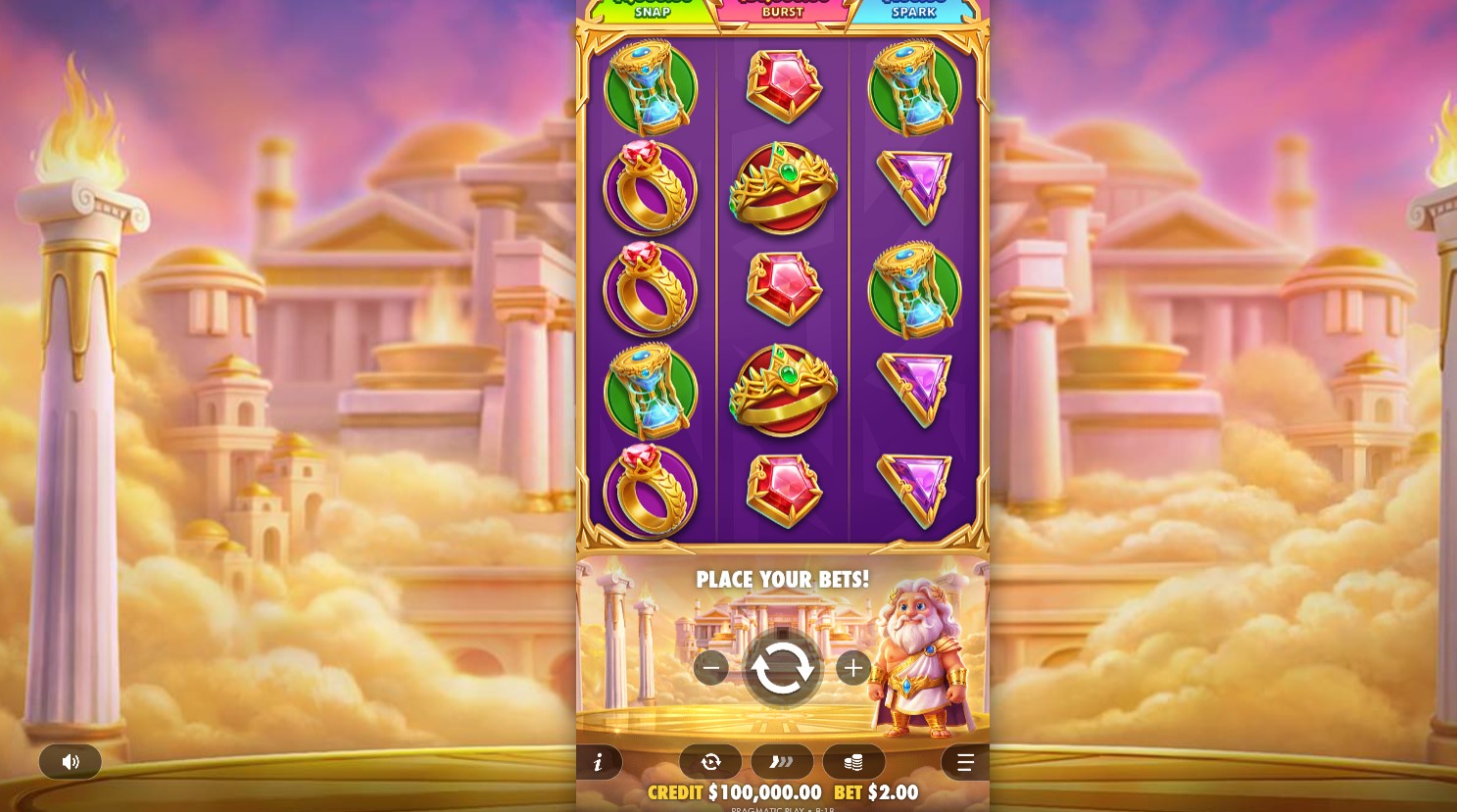
Gates of Olympus POP (Pragmatic Play) Slot Review
After more than ten years of playing online slots, I’ve reached the point where another Gates of Olympus release needs a very clear reason to exist. The original game became one of Pragmatic Play’s defining slots, and since then Zeus has appeared in enough sequels, special editions, Dice versions, Super Scatter releases, live casino crossovers and related titles that simply putting him back on the screen with a new logo is not enough anymore. Gates of Olympus POP is interesting because it actually changes the basic mathematical identity of the series. Instead of the familiar 6×5 tumble setup where you chase groups of eight matching symbols and hope multiplier bombs land on the same sequence, this version shifts into a much smaller 3-reel, 5-row cluster format, with wins formed by five or more matching symbols anywhere on the grid. Current game listings also put the default RTP at around 97.05%, with maximum potential reaching 25,000x the stake, which already tells you this is not simply the original Gates with a cosmetic redesign.
That difference matters more than the theme. Zeus is still Zeus, the gold-and-purple Olympus presentation is instantly recognizable, and Pragmatic Play clearly wants players to understand that this belongs to the same franchise. Mechanically, though, Gates of Olympus POP feels more compact and more focused on cluster formation, repeated symbol interaction and special POP-style feature activity rather than recreating the original game’s exact tumble-and-multiplier rhythm. After years of playing Gates variants, I actually think that is the right direction. If Pragmatic Play is going to keep expanding this series, I would much rather see it change the reel structure and mathematical flow than simply increase the multiplier ceiling again.
Gates of Olympus POP Slot Information
| Feature | Details |
|---|---|
| Provider | Pragmatic Play |
| Series | Gates of Olympus |
| Theme | Zeus / Ancient Greece / Olympus |
| Reel Layout | 3 Reels × 5 Rows |
| Win Mechanic | Cluster Pays |
| Minimum Cluster | 5 Matching Symbols |
| RTP | Around 97.05% default |
| Maximum Win | Up to 25,000x |
| Volatility | Medium to lower than classic Gates variants |
| Hit Frequency | Around 28.82% according to current listings |
| Special Features | POP-style symbol mechanics / jackpot features |
| Mobile Compatible | Yes |
The 3×5 grid, cluster-pay format, 97.05% RTP, 28.82% hit frequency and 25,000x maximum win are reported in current game listings for Gates of Olympus POP.
A Very Different Gates of Olympus Layout
The first thing that feels strange if you have spent years playing the original Gates of Olympus is how small the board looks. Pragmatic Play’s classic version and several of its direct successors use a 6×5 layout, while Gates of Olympus POP compresses the game into three reels and five rows. That sounds like a minor technical detail, but it changes the way you read every spin. Instead of watching a broad field of symbols and looking for eight or more identical icons anywhere across the grid, you are dealing with a much tighter cluster system where five or more matching symbols can create the winning formation.
I actually like the change because the original Gates formula has been copied and reworked so many times that I no longer need another game that behaves exactly the same. On the smaller board, symbol placement feels more concentrated. You can see much more quickly whether a cluster is starting to develop, and the relationship between neighboring symbols becomes more important than simply having enough of one icon scattered across a large grid.
The result is a faster visual read. I can look at the board almost immediately and understand where the potential is, which works particularly well on mobile.
Zeus Returns, But the Game Feels Less Familiar
Visually, Pragmatic Play has not thrown away the recognizable Gates of Olympus identity. Zeus remains the dominant figure, surrounded by celestial architecture, purple skies, glowing gold, gemstones and the familiar divine atmosphere that has become inseparable from the series. Anyone who has played the original game will recognize the visual language almost instantly.
The difference is that the compact grid makes the whole game feel more arcade-like and less monumental. Gates of Olympus originally relied on a large reel field and tumbling chains that could keep going while multiplier symbols collected around them. POP feels more concentrated. The board is smaller, the action resolves quickly, and the special mechanics have less empty space to hide in.
That works surprisingly well with the “POP” title. The game feels like it is designed around short bursts of activity rather than long dramatic tumble sequences.
After ten years of slots, I appreciate when a sequel or spin-off actually changes the rhythm rather than simply repainting the same mathematics.
Cluster Pays Instead of the Classic Gates Formula
The biggest structural change is the move to cluster pays. Current listings describe wins as requiring at least five matching symbols anywhere on the reels rather than following ordinary paylines.
This is a major departure from the familiar Gates setup. In the original game, you need eight or more matching symbols anywhere on the 6×5 grid, and winning symbols then tumble away, allowing new icons to fall into position. In Gates of Olympus POP, the compact cluster system makes the board much easier to read and creates a different kind of tension.
You are no longer waiting for a huge field of matching symbols.
You are watching whether a small group can become large enough to qualify.
That distinction makes the game feel less like a direct sequel and more like an alternative Gates format using the same character and mythology.
Personally, I think that is exactly what Pragmatic Play needed to do with this series.
The POP Mechanic
The name tells you that the game is built around symbols popping out of the board and allowing the reel state to continue developing. That gives the game a much more immediate feel than a conventional fixed-grid slot. Winning clusters do not simply sit there while the payout counter updates; the board reacts, symbols disappear, and new opportunities can emerge from the resulting spaces.
The important part is what happens when this process continues. One small cluster creates the first win, the board changes, another group forms, and suddenly one paid spin has produced several stages of action. This is the same reason tumble and cascade mechanics remain popular after all these years: they make one spin feel like a sequence rather than one static result.
What I like in Gates of Olympus POP is that the smaller grid makes each new symbol more important. On a 6×5 board, one replacement icon can disappear into the visual noise. On a 3×5 board, the same symbol can noticeably change the entire configuration.
Medium Volatility Changes the Gates Experience
One of the most interesting details is that current listings describe Gates of Olympus POP as medium or relatively low volatility compared with the usual Gates releases, with a hit frequency around 28.82%.
That is a major philosophical shift.
The original Gates of Olympus became famous partly because of its brutal high-volatility character. Long stretches of weak spins could suddenly be interrupted by a multiplier-heavy tumble where several bombs added together and changed the entire session.
POP appears to smooth that rhythm out considerably.
You are still dealing with variance, obviously, but the game seems designed around more frequent interaction and less dependence on one extremely rare multiplier chain. For some long-time Gates players, that may actually feel strange. If you open every Zeus game specifically because you want maximum chaos, POP may seem calmer than expected.
Personally, I think that is one of the most interesting reasons to play it.
We already have plenty of savage Gates variants.
A different mathematical profile gives this one an actual reason to exist.
RTP Around 97.05%
The reported 97.05% default RTP immediately caught my attention because that is unusually strong compared with many modern slot configurations.
As always, players should check the exact RTP shown inside the casino because Pragmatic Play games can sometimes be supplied in multiple RTP configurations, and operators may not necessarily use the highest one. But if the 97.05% version is the one actually available, that is a very respectable theoretical return for a modern slot.
After years of playing, I pay more attention to this than I used to. A flashy 50,000x maximum win is nice marketing, but the long-term mathematical structure matters much more if you are actually going to spend time playing the game.
A higher RTP does not guarantee a profitable session, of course.
It simply means the theoretical house edge is lower over an enormous sample size.
The 25,000x Maximum Win
Current game listings put the maximum potential at 25,000x the stake.
That is still a huge ceiling, but compared with some of the most aggressive Gates titles, it is interestingly restrained. For example, the classic Gates family has often been marketed around enormous multiplier-driven headline potential, while later games like Olympus Wins push the maximum even further. Pragmatic Play’s official Olympus Wins page advertises up to 100,000x in that game.
I actually think 25,000x fits POP better. If the game is intentionally moving toward a more frequent-hit, medium-volatility profile, it makes sense not to design the entire mathematical model around a microscopic chance of one absurd 100,000x result.
Twenty-five thousand times the bet is still more than enough ceiling for almost any player.
The important question is whether the game produces enough entertaining intermediate results to make the journey enjoyable.
Spark and Burst Jackpot Features
One of the more interesting additions reported in current information is the presence of Spark and Burst jackpot mechanics, giving Gates of Olympus POP additional targets beyond simply forming clusters. Current reviews describe these jackpots as part of the game’s special feature structure and one of the reasons the calmer mathematical profile still has something larger to chase.
I like this idea because a lower-volatility Gates spin-off needs some kind of feature that creates occasional spikes in anticipation. If the game simply produced frequent clusters with no larger objective, it could become repetitive fairly quickly.
Jackpot-style features solve part of that problem.
You have the regular cluster action to keep the base game moving, while the Spark and Burst mechanics provide another level of potential when the right conditions appear.
The important thing is that these features should feel integrated rather than like random prize labels stuck onto the side of the screen.
How the Base Game Feels
The base game is probably where Gates of Olympus POP differs most from what I normally expect from Zeus. It feels less punishing and more active, with the smaller cluster requirement giving the board more frequent opportunities to produce something.
That does not automatically mean the payouts are larger.
Frequent wins can still be small.
But psychologically, the game feels different because there are fewer long stretches where the screen seems completely disconnected from your stake.
After ten years of playing volatile slots, I find there are sessions where I genuinely prefer this kind of structure. I don’t always want to sit through fifty dead or tiny-return spins waiting for one multiplier bomb sequence to rescue everything.
Sometimes I want the game to keep moving.
POP seems much more suited to that style.
How Does It Compare With the Original Gates of Olympus?
This is the comparison that matters most.
The original Gates of Olympus uses a 6×5 grid, wins from eight or more matching symbols, tumbles, and multiplier symbols capable of reaching 500x individually, with multiple multipliers added together on a winning sequence.
Gates of Olympus POP feels like a different branch of the family.
Instead of trying to replicate that structure, it shrinks the board, changes the win mechanic to five-symbol clusters, lowers the volatility profile, and shifts the focus toward POP reactions and jackpot-style features.
For me, that makes it considerably more interesting than another direct sequel.
If I want the original experience, the original game still exists.
If I want the same Zeus character with a different mathematical rhythm, POP actually provides that.
POP vs Gates of Olympus Dice
Pragmatic Play has already experimented with the franchise through Gates of Olympus Dice, which keeps a 6×5 grid but changes the symbols and uses adjacent clusters of eight or more matching dice symbols. Pragmatic Play’s official page also confirms tumble wins and multiplier symbols from 2x to 500x in Dice.
POP goes further.
Dice still feels mechanically connected to the original Gates because the board size, tumbles and large multiplier symbols remain familiar. POP shrinks the grid and changes the pacing much more aggressively.
That makes POP feel like the more experimental of the two.
And frankly, by this stage of the Gates franchise, experimentation is what I want.
POP vs Gates of Olympus Super Scatter
Gates of Olympus Super Scatter stays much closer to the classic formula. Pragmatic Play’s official information confirms that it still uses matches of eight to thirty symbols, tumble mechanics and multipliers up to 500x, while the Super Scatter provides additional instant-win and bonus potential.
POP is different because it changes the underlying structure instead of adding another premium feature to the existing one.
That’s why I would not think of POP as a direct replacement for Super Scatter.
They are aimed at different moods.
Super Scatter is for players who want the familiar Gates volatility with another expensive-looking feature layered on top.
POP is for players who want Zeus but are willing to accept a completely different rhythm.
Mobile Experience
The 3×5 layout is almost ideal for mobile play. There is very little wasted space, the symbols can remain large, and you do not need to zoom mentally across thirty positions looking for eight matching icons.
On a smartphone, the compact grid actually feels more natural than some of the larger Gates layouts.
The POP animations remain easy to follow, and the smaller board makes it obvious when a new symbol has created or destroyed a potential cluster.
Pragmatic Play has been building mobile-first slots for long enough that performance is not really the concern here. The interesting part is how well the mathematical structure itself suits the screen size.
In that respect, Gates of Olympus POP may be one of the more mobile-friendly Gates variants.
My Playing Experience
After ten years of playing online slots, what I like most about Gates of Olympus POP is that it does not feel obligated to imitate the game that made the franchise famous.
That sounds simple, but it matters.
There are already enough Gates variants where I know exactly what I am waiting for: a tumble win, Zeus throws a multiplier bomb, another tumble lands, and hopefully several multipliers stack together.
POP makes me read the board differently.
I am looking at clusters.
I am watching how the smaller grid changes after symbols disappear.
I care much more about one replacement symbol because it occupies such a large percentage of the available board.
That gives the game a distinct rhythm.
It still feels like Gates of Olympus visually.
But it does not feel like I am playing the same slot again.
The Less Brutal Gates Experience
One of the things that could divide experienced players is the lower volatility. Current information describes POP as much calmer than the traditional Gates games.
Some players will love that.
Others may hate it.
If your entire reason for playing Gates of Olympus is chasing those ridiculous multiplier sequences where the session can change in seconds, POP might feel too restrained. You may see more frequent activity but less of the savage all-or-nothing tension that made the original famous.
Personally, I think the franchise is large enough to support both approaches.
We don’t need every Zeus game to punish the balance in exactly the same way.
When the POP Mechanic Goes Nowhere
More frequent activity does not mean every sequence becomes valuable.
This is where the game can still frustrate you.
A cluster appears.
Symbols pop.
New ones fall into position.
Another small cluster forms.
Everything looks active.
Then you look at the total return and realize the entire sequence barely produced anything.
That is the danger with lower- or medium-volatility cascade games. They can create lots of visual movement without equivalent financial movement.
After years of playing, I try not to confuse the two.
A long POP sequence is entertaining.
It is not automatically a strong sequence.
The values underneath still matter.
What Could Be Better?
The first obvious weakness is franchise fatigue. Zeus has appeared in so many Pragmatic Play releases that even a genuinely different mathematical structure may struggle to excite players who are simply tired of seeing him.
The second issue is that the compact board can feel less spectacular than the classic 6×5 Gates grid. If you enjoy seeing huge screens full of premium symbols and multiplier bombs, POP naturally feels more contained.
The lower volatility will also divide players. Gates fans who specifically want brutal high-risk gameplay may see the more frequent-hit profile as a downgrade rather than an improvement.
Finally, cluster sequences can look busier than they pay. A board popping several times does not automatically mean the result is substantial, and that gap between animation and actual value can become repetitive during a weaker session.
Pros & Cons
Pros: Gates of Olympus POP gives the Gates franchise a genuinely different mathematical identity rather than simply increasing multipliers again. The compact 3×5 grid is easy to read, five-symbol cluster wins keep the board active, the reported 97.05% default RTP is unusually attractive for a modern slot, and the 25,000x maximum win still leaves plenty of upside. The Spark and Burst jackpot-style features provide additional objectives, while the lower volatility makes POP more approachable for players who find the original Gates formula too punishing. The compact layout also works extremely well on mobile.
Cons: Players who love the brutal multiplier-heavy identity of the original Gates of Olympus may find POP too calm, while the smaller board naturally feels less spectacular than the classic 6×5 format. Zeus franchise fatigue is also real, and the frequent POP activity can sometimes create more animation than meaningful payout. Players should additionally verify the RTP offered by their specific casino rather than assuming every operator uses the reported 97.05% configuration.
Who Should Play Gates of Olympus POP?
Gates of Olympus POP is best suited to players who like the Gates of Olympus universe but want something mechanically different from another high-volatility multiplier-bomb sequel. If you enjoy cluster wins, faster board reactions and a more frequent-hit mathematical profile, this version has a real reason to exist.
I would also consider it one of the more approachable Gates releases for players who found the original too harsh. Current listings describing medium-to-lower volatility and a hit frequency around 28.82% suggest a game designed to keep sessions more active rather than concentrating most of the experience around extremely rare explosive sequences.
On the other hand, if the reason you play Gates is specifically to chase huge Zeus multipliers during savage tumble chains, I would probably stay with the original, Super Scatter or one of the more aggressive variants.
POP has a different personality.
That’s the point.
Our Verdict
After more than ten years of playing online slots, Gates of Olympus POP is one of the more interesting Gates spin-offs precisely because Pragmatic Play has finally changed something fundamental rather than simply putting a larger number in the title. The 3×5 layout, five-symbol cluster system and calmer volatility profile give the game a noticeably different rhythm, while the reported 97.05% RTP and 25,000x maximum potential make the mathematics interesting on paper as well.
The compact board takes a little adjustment if you are used to the original Gates of Olympus, but after a few rounds I actually appreciate how much more important each position feels. One symbol can change a large part of the board, POP sequences are easy to follow, and the game doesn’t need the same giant multiplier-bomb spectacle to create tension. The Spark and Burst-style jackpot features also give the game another target beyond ordinary cluster wins.
The trade-off is obvious. This does not feel as savage as classic Gates. Players who want Zeus to spend half an hour doing nothing and then suddenly throw enough multipliers onto one tumble to change the entire session may find the new pacing almost too civilized. But after so many sequels, I think that difference is a strength rather than a weakness.
Gates of Olympus POP actually feels like a spin-off, not a reskin. It keeps Zeus, Olympus and the recognizable Pragmatic Play presentation, but changes how I read the board and what I am hoping to see on each spin. At this point in the franchise, that matters more to me than another increase in the theoretical maximum multiplier.
Rating: 9.4/10
Gates of Olympus POP takes a franchise famous for savage 6×5 tumble sessions and squeezes Zeus into a much tighter, faster cluster game. It may not have the same brutal rhythm as the original, but that is exactly why it works: smaller board, more immediate POP action, a strong reported RTP and enough 25,000x upside to keep Olympus interesting without making every new Gates release feel like the same thunderbolt in a different package.