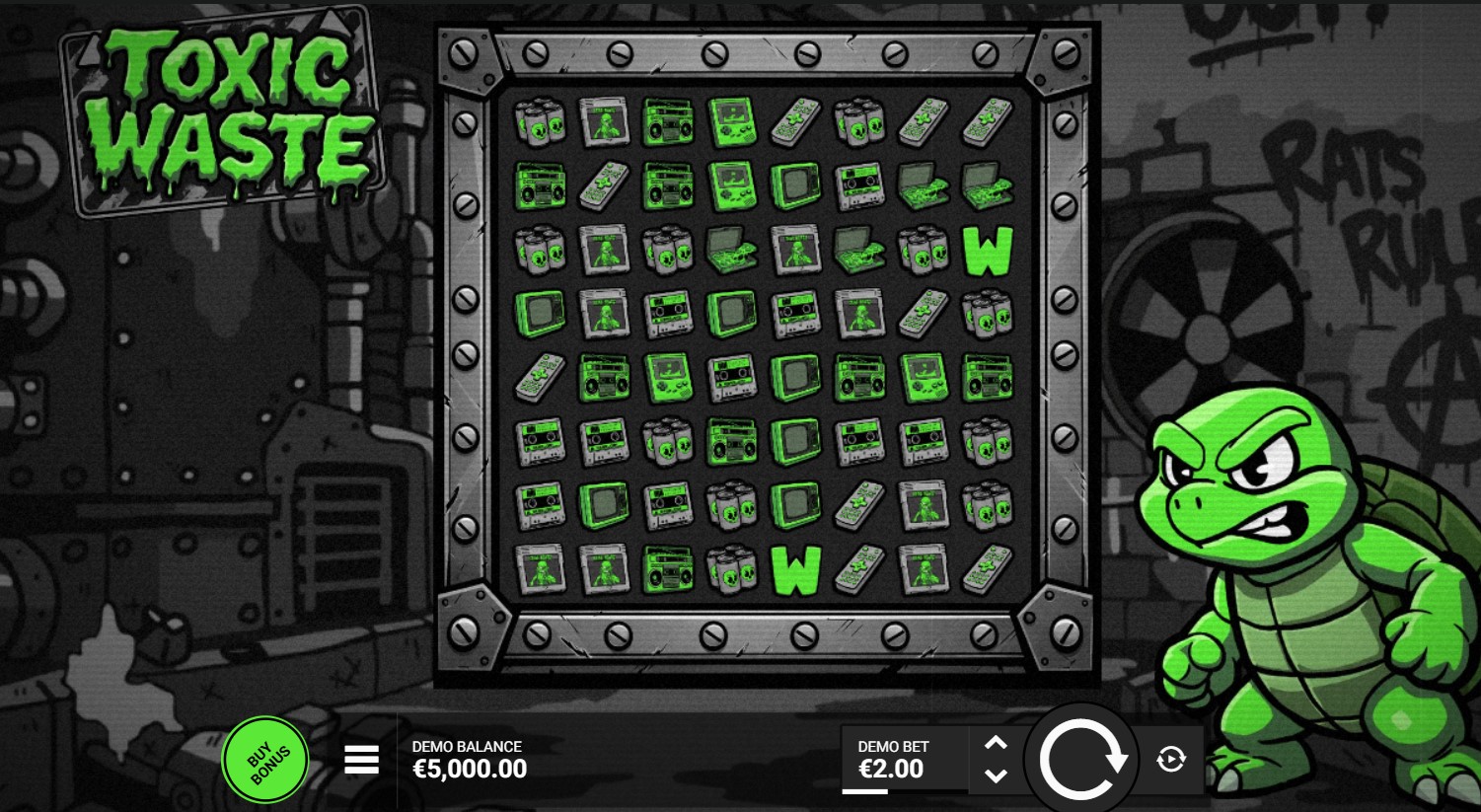
Toxic Waste (Jinx Gaming) Slot Review
After more than ten years of playing online slots, I’ve become suspicious of almost every game that arrives with an 8×8 grid, cluster pays and some kind of growing position multiplier. There are a lot of them now, and the formula is easy to recognize: fill the screen with brightly colored symbols, let winning clusters disappear, put multipliers onto individual positions and hope the board keeps producing new wins before the sequence dies. Toxic Waste from Jinx Gaming uses exactly that broad foundation, but the interesting part is the way it handles its multiplier spaces and the three different bonus modes. Instead of simply building one global multiplier, the game can permanently increase values on individual grid positions during an active sequence, while Chemical Spills, mutated 2×2 symbols and guaranteed feature effects inside the bonuses create a much more aggressive version of the same basic idea. Current specifications list an 8×8 cluster grid, 96.34% standard RTP, high volatility, 35.3% hit frequency and a 10,000x maximum win.
That already tells me a lot about the kind of player Toxic Waste is aimed at. This is not a relaxed old-school slot where the reels stop, a line pays and you immediately move on. The whole appeal is watching the board contaminate itself with better multiplier positions, then trying to keep the same sequence alive long enough for one of those positions to become useful. The psychological trick is very effective because the board visibly becomes more valuable while you play it. Once one square reaches a good multiplier, you stop caring about the generic cluster and start hoping the next winning symbols touch that exact part of the grid.
There is one timing detail worth mentioning if this review is published immediately. Current listings place the general release of Toxic Waste on August 26, 2026, so as of August 19 this is still technically a pre-release title despite demos and preview information already circulating. The mechanics and mathematical information are already detailed enough to analyse properly, but I would still check the final in-game information panel once casinos begin carrying the live release because Jinx Gaming provides at least two RTP configurations.
Toxic Waste Slot Information
| Feature | Details |
|---|---|
| Provider | Jinx Gaming |
| Theme | Radioactive Waste / Mutant Laboratory |
| Grid | 8×8 |
| Win Mechanic | Cluster Pays |
| Main Mechanic | Position Multipliers |
| Chemical Spill | Yes |
| Mutated Symbols | 2×2 symbols |
| Bonus Modes | Biohazard, Radioactive & Contamination |
| RTP | 96.34% / 94.22% |
| Hit Frequency | 35.3% |
| Volatility | High |
| Maximum Win | 10,000x |
| Minimum Bet | 0.10 |
| Maximum Bet | 100 |
| Bonus Buy | Three options |
| Release Date | August 26, 2026 |
The current specification set is unusually consistent across multiple previews: Toxic Waste uses eight reels and eight rows, cluster pays, two RTP configurations of 96.34% and 94.22%, a 35.3% hit frequency, high volatility and a 10,000x cap, while the bonus structure offers three distinct feature levels.
Theme and Graphics
Visually, Toxic Waste goes straight for the obvious radioactive-laboratory aesthetic: glowing chemicals, neon toxic sludge, contaminated machinery, mutated symbols and an industrial wasteland atmosphere. Current previews describe the game as combining radioactive labs, mutant experimentation, neon colors and a grimy arcade-like presentation rather than taking the apocalypse particularly seriously.
I think that is the correct approach. If a slot is called Toxic Waste, I do not need a realistic documentary about environmental contamination. I want glowing barrels, toxic spills and symbols that look like they have been sitting beside a leaking reactor for three years. Jinx Gaming gives the theme enough visual aggression to match the mechanics without making the screen unreadable.
That matters enormously on an 8×8 grid. Sixty-four positions can become visual chaos very quickly, especially once several multiplier values are visible at the same time. The most important design job here is not making the toxic sludge look beautiful; it is making sure I can immediately tell which grid positions have become valuable and where the next cluster needs to form.
Toxic Waste generally succeeds because the multiplier values remain the visual priority once they start developing.
How Toxic Waste Plays
The game uses an 8×8 cluster-pay grid, so wins are created from connected groups of matching symbols rather than traditional paylines. The broad objective is simple enough: create a qualifying cluster, let the game resolve it, then hope the resulting board continues producing additional wins while the special mechanics improve individual positions.
This is where the slot becomes much more interesting than a static grid game. One initial cluster might be financially unremarkable, but if it creates or improves a useful multiplier position, the value of that spin is no longer just the first payout. You are now thinking ahead.
Where will the new symbols fall?
Can another cluster hit the multiplier space?
Will a Chemical Spill improve the right area?
Can the sequence survive long enough to exploit what has already been built?
That is the actual game.
Position Multipliers
The position multiplier system is the central mechanic in Toxic Waste. Winning and feature activity can leave individual grid spaces carrying multiplier values, allowing specific areas of the board to become increasingly important as a sequence develops. Current reviews describe these multiplier spaces as evolving positions that remain relevant throughout the active sequence rather than simply awarding a one-off multiplier.
This is the part I like most, because it changes the way I read the grid. At the start, sixty-four positions are basically equal. Once one square carries a meaningful multiplier, they are not equal anymore.
Now I have a target.
If another useful multiplier position develops nearby, the board becomes even more interesting because future clusters have more opportunities to interact with valuable areas.
That creates a very natural progression:
ordinary board → multiplier space → stronger multiplier space → cluster touches it → payout jumps.
Simple to understand, much harder to actually get.
The Limitation of the Multiplier Spaces
There is also an important wrinkle in Toxic Waste that prevents the position-multiplier system from feeling identical to every other game using this concept. Current analysis notes that only the highest applicable multiplier space is used at once, rather than combining all touched multiplier positions into one enormous total.
This will divide players.
On the positive side, it keeps the mathematics more controlled and gives you one clear target to improve. On the negative side, it can feel frustrating when several good multiplier spaces exist on the grid but the game does not simply add them all together.
Personally, I understand the criticism. There is something incredibly satisfying about building several position multipliers and eventually hitting a cluster that combines all of them. Toxic Waste sacrifices part of that explosive possibility in exchange for a system where the best individual space matters most.
That makes the feature feel more tactical visually, but slightly less explosive mechanically.
Chemical Spill
Chemical Spill is one of the defining modifiers and is especially important inside the bonus rounds. Current previews describe Chemical Spills as improving individual multiplier spaces, with stronger bonus modes guaranteeing that spills occur during the feature.
This is where the theme and mathematics actually line up nicely. The toxic material spreads across the grid, and instead of simply being an animation, it changes the value of positions on the board.
A spill on a useless part of the grid may not do much immediately.
A spill that improves a position sitting inside an area where clusters are already developing can become considerably more important.
This is why the same mechanic can feel completely different from one spin to another.
The Chemical Spill itself is not the win.
It creates the place where you want the win to happen.
Mutated 2×2 Symbols
Toxic Waste also uses mutated 2×2 symbols, which occupy multiple grid positions and give the 8×8 layout another way to create larger or more connected symbol groups.
I like oversized symbols in cluster games when they genuinely help create structure rather than simply making the board look more dramatic. A 2×2 symbol represents four connected positions immediately, which can dramatically change how easy it is for adjacent matching symbols to form a useful cluster.
More importantly, a mutated symbol landing near an already valuable multiplier space can create exactly the kind of board state Toxic Waste is designed around: larger symbol coverage plus a strong target square.
That is when the mechanic stops being visual decoration and becomes genuinely useful.
Building the Grid
The best Toxic Waste sequences should have a clear progression rather than one random giant hit. The first cluster establishes the spin, Chemical Spill improves one or more positions, a mutated symbol helps create another connection and eventually a larger cluster lands across the strongest multiplier square.
That’s the sequence I am looking for.
The game becomes less about the individual symbols and more about the geography of the grid.
After ten years of playing slots, I actually like that kind of mathematical storytelling. I want to know where I need the next group to form, not simply which premium icon needs to land.
Once a multiplier position becomes serious, I can immediately see the destination.
Now the game simply has to get me there.
Easier said than done.
Biohazard Bonus
Toxic Waste includes three feature levels, starting with the Biohazard Bonus. Current feature descriptions say the different bonuses are triggered through escalating Scatter requirements, with three, four or five Scatters corresponding to increasingly strong feature states.
The Biohazard version is therefore the entry-level feature. Its real attraction is that bonus spins provide much more time for multiplier spaces and Chemical Spills to develop than a normal isolated base-game sequence.
That extra time matters enormously.
One multiplier square isn’t particularly exciting.
A multiplier square that keeps getting improved across several bonus opportunities can become the focus of the entire feature.
The problem, naturally, is getting clusters to use it.
You can build a beautiful position multiplier and then spend several spins watching winning symbols form everywhere except the one bloody square you need.
Classic slot behaviour.
Radioactive Bonus
The Radioactive Bonus represents the stronger middle tier of the three feature modes, triggered by the corresponding higher Scatter requirement. The logic is straightforward: better entry conditions give the game more room to produce aggressive Chemical Spill and multiplier activity.
This is where I expect Toxic Waste to start showing its real mathematical personality. A stronger starting state makes the position-multiplier mechanic much more interesting because you’re not spending most of the feature simply trying to get the first useful square established.
Instead, you can begin thinking about escalation earlier.
Where is the best multiplier?
Which part of the grid has enough matching symbols around it?
Can a mutated symbol bridge the gap?
Can another spill improve the same area before the sequence dies?
That is much more engaging than simply counting remaining Free Spins.
Contamination Bonus
The headline feature is the Contamination Bonus, triggered from the strongest Scatter configuration. Current feature information says this mode begins with a 2x multiplier on every grid position and guarantees Chemical Spills on every spin, giving the entire 8×8 board a stronger starting state.
Now that is interesting.
Starting with 2x across all sixty-four spaces means every position already has some value before the feature begins developing further. The game is no longer trying to create one multiplier island inside an otherwise neutral board; it is upgrading an already contaminated grid.
This is where the name actually makes mathematical sense.
Everything is toxic.
Everything is multiplied.
Now you are trying to make individual positions much more toxic than the rest.
If Chemical Spills repeatedly hit useful areas while clusters continue landing through those positions, the Contamination Bonus should provide the strongest version of what Toxic Waste is trying to do.
Guaranteed Chemical Spills
All three bonus modes are currently described as providing guaranteed Chemical Spills on every spin, with the Contamination Bonus adding the full-board 2x starting multiplier.
This is one of the better design choices because it means the bonus cannot simply become ten copies of the base game. Something related to the central mechanic is guaranteed to happen every time.
That doesn’t mean every spin becomes good.
The Spill can improve the wrong part of the grid.
The winning cluster can form somewhere else.
The strongest multiplier square can remain completely untouched.
But at least the feature is always trying to build something.
After years of playing, I prefer this to bonuses where half the spins contain absolutely no feature interaction whatsoever.
Three Bonus Buys
Current game information also states that three separate Bonus Buy options are available, corresponding to the feature modes. That makes perfect sense for a game structured around three escalating bonus tiers.
The appeal is obvious.
Skip the base game.
Choose the feature strength.
Start contaminating the grid.
But the usual warning matters even more with a game like Toxic Waste. Buying the stronger bonus does not guarantee the multiplier spaces will develop in useful locations or that the winning clusters will interact with them properly.
You are buying better starting conditions.
Not the final payout.
That distinction is enormous.
The Contamination Bonus can begin with every square at 2x and still disappoint if the game refuses to connect useful clusters with the stronger positions.
RTP – 96.34% or 94.22%
Jinx Gaming currently offers 96.34% and 94.22% RTP configurations for Toxic Waste.
That is not a trivial difference.
If I have the choice, I want the 96.34% version every single time.
A 94.22% configuration gives the casino a meaningfully larger theoretical edge over long-term play, and this is exactly why I always recommend opening the information screen rather than trusting the RTP from a review page.
Two casinos can offer the same slot with identical graphics and still provide different underlying theoretical returns.
After ten years around online casinos, I pay much more attention to that than I used to.
Check the number.
It takes five seconds.
Hit Frequency – 35.3%
The listed 35.3% hit frequency means winning events should occur reasonably often for a high-volatility grid slot, although hit frequency says nothing about the size of those wins.
This distinction matters enormously in cluster games.
A screen can produce small winning groups frequently enough to feel active while the balance still trends downward because many of those hits return less than the stake.
That is why I never judge a session by the number of animations.
I judge it by actual value.
Cluster.
Symbols disappear.
Another cluster.
More toxic animation.
Looks fantastic.
Total payout: 0.7x.
Technically a winning sequence.
Financially not particularly useful.
High Volatility
Toxic Waste is rated high volatility, 4/5 in current listings. That fits the 10,000x ceiling and bonus structure well because the position multipliers need enough mathematical space to develop into genuinely strong states.
The high volatility will become most obvious when the game gives you plenty of promising grid development without the final cluster needed to exploit it.
You build a 20x square.
Nothing lands through it.
Chemical Spill upgrades it again.
Still nothing.
Now the position is genuinely dangerous.
Sequence dies.
That is far more frustrating than a dead spin because the game showed you exactly where the potential was.
Maximum Win – 10,000x
The maximum payout is capped at 10,000x the stake. That feels perfectly appropriate for the mathematical profile.
I don’t need another 100,000x headline number.
Ten thousand times the stake is already huge.
What interests me more is how Toxic Waste gets there. The position multipliers create a visible route toward larger results rather than hiding everything behind one ultra-rare jackpot symbol.
That makes the ceiling feel connected to the core mechanic.
Build multiplier spaces.
Create stronger positions.
Hit them with a large enough cluster.
Repeat while the sequence survives.
That’s a much more interesting journey than simply waiting for one random max-win symbol.
Base Game vs Bonus Features
The base game is mechanically strong enough that it doesn’t feel completely like filler. Chemical Spill, multiplier spaces and mutated symbols can already make a normal spin develop into something more interesting.
Still, the bonuses are clearly where Toxic Waste becomes the game it is supposed to be.
Guaranteed Chemical Spills fundamentally change the rhythm because the board is being improved continuously. The Contamination Bonus pushes that even further by starting the entire grid at 2x.
That gives the bonus a genuine identity instead of simply removing the cost of each spin.
The base game introduces contamination.
The bonus lets it spread.
Toxic Waste on Mobile
An 8×8 grid is always a challenge on mobile because sixty-four positions can become tiny very quickly. Fortunately, the bright symbols and large multiplier values are exactly the kind of visual language that translates reasonably well to a phone.
For me, the most important thing isn’t seeing every radioactive pipe in the background.
I need to see the multiplier map.
Which position is strongest?
Where are the mutated symbols?
Which part of the board is currently capable of forming another cluster?
As long as those things remain obvious, the smaller screen isn’t a serious problem.
I would still prefer desktop for longer sessions simply because an 8×8 multiplier grid benefits from more visual space, but mobile should remain perfectly usable.
My Playing Perspective
After more than ten years of playing slots, what I like most about Toxic Waste is that the multiplier mechanic gives me a specific part of the board to care about.
That’s more interesting than one global multiplier.
If one square reaches 20x, I want the action there.
If Chemical Spill pushes it to something larger, I care even more.
Now every new symbol drop becomes a question of whether the game can build a cluster through that exact location.
That creates a real sense of geography.
The board develops hotspots.
Some areas are worthless.
Others become dangerous.
That is the main reason I would return to Toxic Waste.
Where the Mechanic Frustrates Me
The biggest frustration is the fact that only the highest applicable multiplier space is used, which reduces some of the explosive satisfaction available in other position-multiplier games.
I understand why Jinx Gaming did it.
It controls the mathematics and gives players one obvious priority.
But there will absolutely be situations where multiple valuable positions are touched by the same cluster and I will wish the game simply combined them.
That would create much more dramatic payoff for building several strong squares.
Instead, Toxic Waste asks you to focus on the best one.
Different design choice.
Not necessarily bad.
But I can see why some players will prefer the additive systems used elsewhere.
When the Laboratory Produces Absolutely Nothing
The cold sessions will look something like this:
Small cluster.
Chemical Spill hits useless corner.
Another cluster.
Multiplier develops somewhere else.
Next spin builds a good multiplier square.
Winning symbols avoid it completely.
Bonus triggers.
Guaranteed Spill every spin.
Beautiful grid.
Final payout mediocre.
This is the strange contradiction of Toxic Waste.
The board can become mathematically interesting without becoming financially successful.
That distinction is incredibly important.
A good multiplier map is potential.
It isn’t money until the cluster actually uses it.
Mutated Symbols Can Save a Dead-Looking Board
The 2×2 mutated symbols are particularly useful because they can bridge larger parts of the grid and make a new cluster possible when ordinary single positions would not be enough.
This is where the mechanic becomes more than a visual gimmick.
You can have several matching symbols scattered around one valuable multiplier square without enough direct connection.
Then a 2×2 mutant lands.
Suddenly the entire region becomes connected.
Now the multiplier matters.
Those are exactly the board transformations I want to see because they make the oversized symbol feel like part of the core mathematics rather than something designed purely for spectacle.
The Contamination Bonus Is the Main Attraction
For me, the Contamination Bonus is clearly the feature I would want to see most often, simply because starting every grid position at 2x immediately transforms the game.
A normal board contains neutral spaces and a handful of developing multipliers.
The Contamination board is already upgraded everywhere.
That means the Chemical Spills are enhancing an existing multiplier map from the beginning.
The interesting question becomes how concentrated the strongest positions can become before the feature runs out.
If several Spills repeatedly hit the same area, the board can develop a very obvious hotspot.
Now you simply need the winning cluster to cooperate.
“Simply.”
Right.
The Almost-Perfect Toxic Waste Bonus
This will probably be the feature outcome players remember most painfully.
Strong multiplier space.
Repeated Chemical Spill improvement.
Mutated symbol creates excellent coverage.
Premium cluster almost forms.
One symbol missing.
Next spin:
wrong symbol.
Feature over.
That is much worse emotionally than a bonus that paid badly from the start because the game showed you exactly what the strong result needed.
Progression creates investment.
Investment creates pain when the final connection never arrives.
Good slot design can be very annoying.
What Could Be Better?
The first weakness is originality of the underlying structure. Position multipliers on a cluster grid are already familiar, and current reviewers have made the same criticism: Jinx Gaming changes the implementation but doesn’t completely reinvent the formula. The radioactive theme also fits the mechanics well but isn’t especially unusual in modern casino games.
The second issue is the single-highest-multiplier rule. Building several strong positions can feel less rewarding when only the best applicable value matters instead of combining multiple multipliers.
The alternative 94.22% RTP configuration is another clear negative. I would actively look for a casino offering the 96.34% version if both are available.
Finally, high volatility means plenty of excellent-looking multiplier maps will fail to produce the cluster needed to exploit them.
Pros & Cons
Pros: Toxic Waste has a strong 8×8 cluster structure, an excellent thematic connection between Chemical Spills and growing position multipliers, mutated 2×2 symbols that can genuinely change cluster geometry and three bonus modes that progressively strengthen the central mechanic. The top-tier Contamination Bonus begins every grid space at 2x and guarantees Chemical Spill activity, while the 96.34% RTP configuration is competitive and the 10,000x maximum gives the game plenty of upside.
Cons: Position multipliers are not a new concept, and the system only applying the strongest relevant multiplier can feel less explosive than games where multiple grid multipliers combine. High volatility means strong multiplier positions can disappear without ever being used, the 94.22% RTP configuration is substantially less attractive, and the core gameplay may become repetitive for players who have already spent a lot of time with cluster-multiplier slots.
Who Should Play Toxic Waste?
Toxic Waste is best suited to players who enjoy high-volatility cluster slots where the board itself develops during a sequence. If you like watching individual positions become stronger, targeting multiplier hotspots and hoping mutated symbols or additional clusters eventually interact with those spaces, Jinx Gaming has built a feature system that gives you plenty to follow.
It should also appeal to players who enjoy bonus progression. Biohazard, Radioactive and Contamination create three levels of the same central concept rather than three completely unrelated gimmicks, and that mechanical consistency helps the game feel coherent.
Players who dislike cluster games, prefer fixed paylines or want multipliers to stack together aggressively may find the system less satisfying.
And check the RTP before playing.
96.34%.
Not 94.22% if you can avoid it.
Our Verdict
After more than ten years of playing online slots, Toxic Waste is the kind of game I respect more for the structure of its feature system than for the individual mechanics themselves. Cluster pays are familiar. Position multipliers are familiar. Oversized symbols are familiar. But Jinx Gaming puts them together in a way that makes the toxic contamination theme genuinely relevant to what is happening mathematically.
The best sequences have a clear progression. A cluster gets the board moving, Chemical Spill creates or improves a multiplier hotspot, a mutated 2×2 symbol helps connect a larger group and eventually another winning cluster lands across the strongest position. The board has changed from sixty-four ordinary squares into a map where one or two areas matter enormously.
That is good feature design.
The bad sessions are equally easy to understand. You build the perfect multiplier square and then spend the rest of the sequence watching clusters form everywhere except that position. Or you enter the Contamination Bonus, start with 2x across the entire grid, receive guaranteed Chemical Spills and still never get enough useful symbol connection to turn all that beautiful contamination into a meaningful payout.
That’s where the high volatility bites.
Still, Toxic Waste gives Jinx Gaming a solid identity inside the crowded grid-slot market. The 96.34% RTP option is respectable, 10,000x is more than enough ceiling, and the three escalating bonus modes provide a clear reason to chase stronger feature states. I would have preferred the multiplier positions to combine more aggressively, but the Chemical Spill system gives the game enough tension to make those glowing squares genuinely worth watching.
Rating: 9.2/10
Toxic Waste is exactly what a good radioactive slot should be: the longer the feature survives, the more dangerous parts of the board become. Build the multiplier hotspots, let the Chemical Spills contaminate the right positions, use those mutated 2×2 symbols to connect the grid and then hope the next cluster lands where the radiation is strongest. When it does, Jinx Gaming’s toxic little laboratory can turn one ordinary cluster into something considerably nastier.