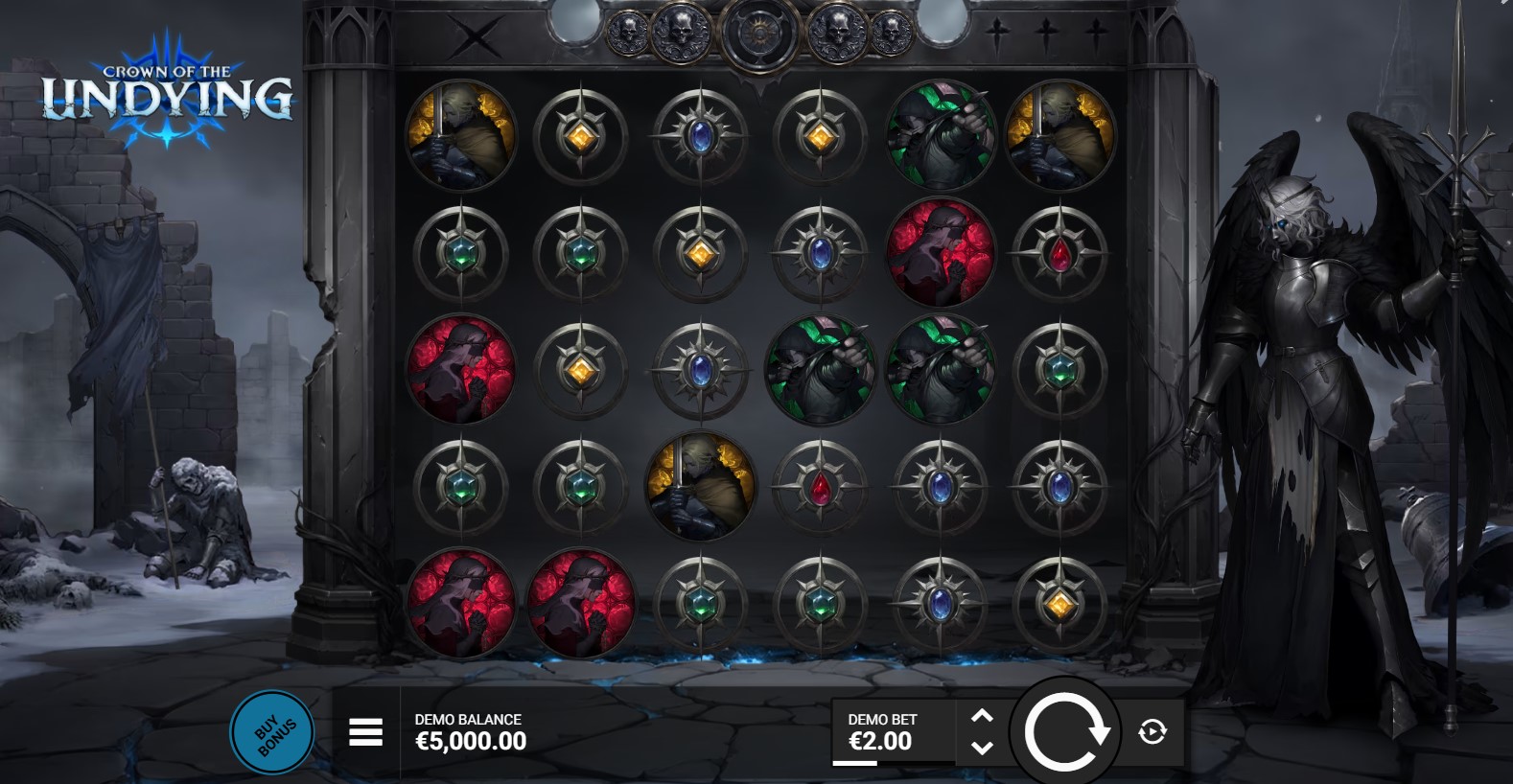
Crown of the Undying (Foxhound Games) Slot Review
After more than ten years of playing online slots, I’ve become very difficult to impress with dark-fantasy themes. Undead kings, cursed crowns, ancient tombs, ghostly knights and ruined castles have appeared often enough that a game can look fantastic in screenshots and still become completely forgettable after twenty minutes. Crown of the Undying from Foxhound Games avoids that problem because the theme is backed by a surprisingly coherent mathematical structure. This is a 6×5 cluster-pays slot with Avalanche-style cascades, a Total Multiplier system, The Mark mechanic, persistent feature progression and a 10,000x maximum win, all distributed through Hacksaw Gaming’s OpenRGS platform. The standard RTP is listed at 96.26%, volatility is high, and the game released on July 28, 2026.
What immediately interests me is that Crown of the Undying does not rely on one random giant multiplier to create all of its potential. Instead, the game asks several mechanics to work together. Cascades keep a sequence alive, the Total Multiplier develops as those cascades continue, The Mark creates a target position on the grid, and specific high-paying symbols can trigger different abilities when they land on that marked space. During the bonus, the mechanics become persistent, which changes the entire rhythm because a useful state can survive long enough to become genuinely dangerous. That is exactly the kind of feature progression I tend to prefer now. I would much rather watch a board evolve through several stages than wait for one random 500x bomb to decide whether the session was worthwhile.
The downside is obvious from the numbers. Crown of the Undying has a reported 17.21% hit frequency, so this is not a game designed to constantly reassure you with small wins. There can be stretches where the grid looks fantastic, The Mark appears in promising places and absolutely nothing meaningful connects. That is high-volatility cluster gameplay in its purest form: the strong sequences need enough mathematical room to matter, and that room is created by plenty of ordinary spins that go nowhere.
Crown of the Undying Slot Information
| Feature | Details |
|---|---|
| Provider | Foxhound Games |
| Distribution | Hacksaw Gaming OpenRGS |
| Theme | Gothic / Undead Fantasy |
| Grid | 6 Reels × 5 Rows |
| Win Mechanic | Cluster Pays |
| Cascades | Avalanche Cascades |
| Main Mechanics | The Mark + Total Multiplier |
| RTP | 96.26% |
| Hit Frequency | Around 17.21% |
| Volatility | High |
| Maximum Win | 10,000x |
| Free Spins | Yes |
| Persistent Bonus Mechanics | Yes |
| Bonus Buy | Yes |
| Release Date | July 28, 2026 |
| Mobile Compatible | Yes |
Foxhound Games is the actual developer, while the game is published through Hacksaw Gaming’s OpenRGS platform, which is worth clarifying because some casino databases display Hacksaw more prominently than Foxhound.
Theme and Graphics
Crown of the Undying takes place in a ruined gothic world full of cursed stonework, spectral light, ancient relics and the kind of decaying royal imagery you would expect from a kingdom whose monarch clearly should have stayed dead. The artwork has enough weight that the game feels more like a dark-fantasy title than a generic Halloween slot, and I think that distinction matters. There are no smiling cartoon skeletons trying to sell me a jackpot; the presentation is much closer to a cursed medieval kingdom slowly collapsing under supernatural influence.
The 6×5 grid gives Foxhound enough room to create large symbol groups without making the board overwhelmingly wide, and the darker background helps the premium symbols, Wilds and Mark-related effects stand out. This becomes important during cascade chains because the game can get busy quickly. Symbols disappear, new ones fall in, the Total Multiplier progresses and The Mark may create another feature opportunity, so the artwork needs to stay readable under pressure.
After ten years around online slots, I’ve become much more appreciative of games that know when to stop decorating the screen. Crown of the Undying looks atmospheric, but the mathematical information remains the priority. I can see the target position, understand which symbol activated the feature and follow the cascade without relying entirely on the win counter to explain what just happened.
Cluster Pays and Avalanche Cascades
The core game runs on cluster pays rather than fixed paylines, with matching symbols forming connected groups across adjacent grid positions. Winning clusters disappear through Avalanche Cascades and are replaced by new symbols from above, giving the same paid spin another opportunity to continue.
This already creates a very different rhythm from a conventional five-reel slot. The first win does not necessarily matter much on its own. What matters is whether the cascade can keep going long enough for the other mechanics to become relevant.
A small cluster clears.
New symbols fall.
Another cluster forms.
The Total Multiplier develops.
Now The Mark becomes interesting.
Another cascade.
Suddenly the original 1x or 2x win is almost irrelevant because the entire sequence has moved into a much stronger state.
That is exactly why cascade slots can be so addictive to watch. One paid spin can develop into a little story, and every continuation increases the feeling that something much larger may be building underneath.
The Total Multiplier
The Total Multiplier is one of Crown of the Undying’s central mechanics. Each cascade contributes toward filling the multiplier bar, and once the bar completes, the game can award a random multiplier of up to 100x. Crucially, the Total Multiplier remains relevant throughout the active cascade sequence rather than being treated as a completely disconnected one-off modifier.
This is a much better implementation than simply dropping a random multiplier onto the board because the player can actually watch the feature develop. The cascade chain is building something, and that creates an immediate reason to care about another small win even if the current payout is nothing special.
A tiny cluster may be financially uninteresting.
But if it moves the multiplier bar toward the next activation, suddenly that cluster has another purpose.
That is good mathematical design because the value of an event extends beyond its immediate payout.
The frustrating part, naturally, is building a beautiful multiplier state and then watching the next grid miss completely. Sequence over. Back to zero. All that visible potential disappears at once.
Why the Multiplier Works Better With Cascades
A multiplier system is only interesting if the game has enough opportunities to use it, and that is why the cascade mechanic matters so much. Every additional win gives the multiplier another chance to become relevant before the current sequence ends.
This creates a very natural escalation.
First cascade: nothing special.
Second cascade: multiplier bar developing.
Third: now the state looks interesting.
Fourth: the multiplier activates.
Fifth: finally there is a decent premium cluster underneath it.
That sequence is infinitely more satisfying than seeing “50x” appear randomly before anything else has happened.
You watched the spin earn its own danger.
That is the sort of feature logic I tend to appreciate much more after years of playing.
The Mark Mechanic
The Mark is the mechanic that gives Crown of the Undying its most distinctive identity. At the beginning of a spin, one random grid position is marked. If one of the qualifying high-paying symbols lands on that exact position, it activates that symbol’s specific ability.
I really like this idea because it gives the board a focal point.
Without The Mark, every position on a cluster grid is basically equal until symbols land.
With The Mark, one square immediately matters more.
You are now looking at the entire board differently.
Which premium symbol is near it?
Can the next cascade drop something onto that exact square?
Will the feature fire while the multiplier state is already strong?
That creates the kind of visible target I love in grid slots. I know where I want the action to happen.
The difficulty is obvious: the board can repeatedly produce good symbols everywhere except the one marked position. That is going to be one of the most frustrating recurring experiences in Crown of the Undying.
Wild Volley
One of The Mark abilities is Wild Volley, which introduces Wild symbols onto the grid and can significantly improve cluster formation. This is probably the most immediately exciting of the abilities because Wilds can change the shape of the board rather than simply adding a fixed cash value.
The importance of that cannot be overstated in a cluster game.
One correctly placed Wild can connect two groups that were previously separated.
Several Wilds can turn a mediocre configuration into a proper chain.
And if Wild Volley activates while the Total Multiplier is already strong, the combination becomes considerably more dangerous.
This is the kind of interaction I want: feature improves board, board creates win, multiplier increases value.
Simple mechanics.
Strong relationship between them.
Sarcophagus Prize
Another Mark-triggered feature is the Sarcophagus Prize, which introduces instant cash-value rewards rather than relying entirely on cluster formation. This gives Crown of the Undying a second kind of payout route and prevents every Mark activation from feeling mechanically identical.
Personally, I find Wild Volley more interesting because it has the potential to extend the sequence itself. An instant cash reward is useful, but it is relatively final. Wilds can create another win, which can create another cascade, which can develop the multiplier further.
Still, the Sarcophagus Prize helps give The Mark feature variety. Not every activation needs to behave like the same Wild event with a different animation.
Why The Mark Creates Better Near-Misses
Crown of the Undying is particularly good at making unrealized potential visible because The Mark gives you a target from the beginning.
You know where the feature needs to land.
A premium symbol drops one square away.
Next cascade, another misses.
Now a Wild connects a cluster and gives you one more chance.
Wrong symbol lands on The Mark.
Sequence ends.
That hurts more than a completely dead spin because you can see exactly how close the feature came to activating.
After ten years of playing, I recognize this as one of the most effective forms of slot tension. The game does not need to tell you that you almost triggered something.
The board shows you.
FS Stack Indicator
The Free Spins feature uses an FS Stack Indicator, where qualifying FS symbols contribute stacks toward triggering the bonus. Current information states that filling three stacks awards 10 Free Spins. This is another progression mechanic I prefer over completely binary Scatter hunting because the player can see that the bonus state is moving toward something.
Again, visible progress does not mean the feature is “due.”
That distinction is important.
If you are sitting one stack away, the next spin is not mathematically obligated to finish the trigger simply because the meter looks close. But psychologically, having a visible progression meter makes the base game feel less random because the player can follow how far the feature has developed.
That keeps quieter stretches more tolerable than a game where you simply wait for three Scatters with no sense of accumulated progress.
Free Spins
The Free Spins round is where Crown of the Undying’s mechanics really come together, because both the Total Multiplier and The Mark abilities become persistent across the feature instead of resetting after every individual spin. This is easily the most important difference between base-game play and the bonus.
Persistence changes everything.
In the base game, you may build a useful multiplier and immediately lose it when the cascade ends.
Inside Free Spins, the feature state can survive.
That means something achieved early can make a much later spin more valuable.
This is exactly the kind of bonus design I enjoy.
Spin two matters on spin seven.
The game remembers what happened.
You’re building a state rather than playing ten unrelated free rounds.
Persistent Total Multiplier
The persistent multiplier is probably the feature I would care about most during Free Spins. Once the Total Multiplier has developed, later winning clusters can take advantage of the stronger state without requiring the player to rebuild everything from the beginning.
That creates one of the best forms of bonus progression.
Early feature:
I want cascades.
Middle feature:
I want the multiplier to climb.
Late feature:
Now I want strong premium clusters because the multiplier state has finally become serious.
The objective changes naturally as the bonus develops.
That gives every stage a different purpose and makes the later spins much more exciting if the multiplier has already grown.
Persistent Mark Abilities
The bonus also strengthens The Mark because its feature effects can remain part of the overall bonus progression rather than acting like completely isolated base-game events. This is where the game has its best chance of producing a proper chain reaction.
The Mark fires.
Wilds appear.
A cluster forms.
Cascades continue.
Multiplier improves.
Another marked-symbol ability activates.
Now the board and multiplier are both stronger.
That is the kind of feature state that makes the 10,000x ceiling feel mechanically connected to the game rather than simply printed in the information screen.
Hallowed Death Featurespins
Crown of the Undying includes a Hallowed Death Featurespins mode among its enhanced feature options. Current listings describe this as one of the stronger bonus configurations available through the purchase system.
The appeal is obvious because the regular Free Spins already revolve around persistence, and an enhanced starting state can reduce the amount of time spent building before the interesting mechanics become active.
But this comes with the usual warning.
Enhanced starting conditions are not enhanced guarantees.
You can pay more for a stronger entry point and still receive weak clusters, badly timed Mark activations and a multiplier state that never gets the board required to exploit it.
The mathematics do not care what the entry fee was.
Reign of the Usurper
The premium bonus mode is Reign of the Usurper, which current feature information lists as providing instant access to 10 Free Spins at the strongest configuration, with the purchase priced at around 1,000x the stake.
A thousand times the stake is enormous.
That is not an entry fee I would treat casually.
At €0.10, you’re already talking about €100.
At €1, that’s €1,000 for one purchased feature.
The mathematical potential may be high, but this is still a high-volatility slot with a 10,000x cap. There is absolutely no guarantee the premium feature returns anything close to the purchase price.
The name sounds powerful.
The price is definitely powerful.
The result can still be rubbish.
Bonus Buy RTP – Important Warning
One detail I would not bury is that current information lists the Bonus Buy RTP at 94.33%, which is significantly lower than the standard 96.26% base-game RTP.
That matters.
A lot.
Players sometimes assume buying a bonus simply gives them faster access to the same mathematics.
Not necessarily.
Here, the theoretical return attached to the Bonus Buy configuration is lower.
If I am choosing purely on RTP, I would prefer the 96.26% standard game over a 94.33% purchase mode.
Naturally, players using Bonus Buy are usually chasing concentration of volatility rather than long-term theoretical efficiency, but the difference still deserves to be stated clearly.
Bonushunt Featurespins
There is also a lower-cost Bonushunt Featurespins option, listed around 5x the stake, intended more as an enhancement to bonus hunting than a direct jump into the full premium feature. This kind of option makes more sense to me for players who want increased feature activity without immediately dropping hundreds of stake units on one bonus.
It still alters the mathematical profile, though, so I would treat it as a different mode rather than a harmless convenience button.
The important thing with all these options is understanding what you’re paying for.
Better access.
More feature concentration.
Not guaranteed profit.
96.26% RTP
The standard 96.26% RTP is a respectable figure in the current market. There are enough modern slots appearing around 94% that anything comfortably above 96% gets my attention.
As always, RTP is a long-term theoretical figure.
You can play a 96.26% game and lose every cent during one session.
You can play a lower-RTP game and win immediately.
That does not change the underlying mathematics.
If I have the choice between otherwise identical configurations, I still want the higher RTP.
17.21% Hit Frequency
The listed 17.21% hit frequency explains a lot about the way the game feels. This means winning events are comparatively infrequent, which fits the high-volatility profile and the emphasis on stronger cascade chains.
The important thing is not confusing hit frequency with RTP.
A game can hit less frequently but pay larger average wins when it does connect.
That is the type of experience Crown of the Undying seems built around.
You may go through several spins with very little happening.
Then one cluster creates a cascade.
Another follows.
The multiplier builds.
The Mark activates.
Suddenly one paid spin produces more action than the previous twenty.
That is the entire mathematical personality in miniature.
High Volatility
Crown of the Undying is definitely a high-volatility slot, and I would approach it with that expectation from the beginning. The game is structured around progression, which naturally means many sequences will die before reaching the stronger states.
You build the Total Multiplier.
Next cascade misses.
You get The Mark into a promising position.
Wrong premium symbol.
You build two FS stacks.
Nothing happens for ages.
Then the bonus finally triggers and may still underperform.
That’s the unpleasant side.
The good side is what happens when those same mechanics start cooperating. A Mark feature fires, Wilds improve the board, multiple cascades develop and the persistent multiplier turns the later stage of the sequence into something much stronger.
That’s why players tolerate the dry stretches.
Maximum Win – 10,000x
The maximum payout is 10,000x the stake, which I think fits the game’s mathematical profile well. It is large enough to provide a serious ceiling without pushing the game into those slightly ridiculous 100,000x marketing numbers that often require absurdly rare conditions.
Ten thousand times the stake is already enormous.
At €1, that’s €10,000.
At €5, that’s €50,000.
The important question is whether the route toward that ceiling feels connected to the actual mechanics, and here it does. Persistent multipliers, Mark abilities and long cascade chains provide a logical path toward escalating value.
That is much more satisfying than one random max-win symbol.
Base Game vs Free Spins
The base game is not completely empty because The Mark, cascade progression and the FS Stack Indicator give you several things to follow, but Free Spins are clearly the main destination. The persistent mechanics fundamentally improve the way the game behaves.
In base play, the feature state is temporary.
Inside Free Spins, you get to build.
That one difference changes the entire experience.
A weak base-game sequence can be interesting for a few seconds.
A strong bonus can become increasingly dangerous for several spins because the game remembers what happened earlier.
After ten years of slots, I will take persistent bonus progression over static Free Spins almost every time.
Crown of the Undying on Mobile
The 6×5 grid is large enough to create meaningful clusters but still compact enough to work comfortably on a smartphone. The darker visual palette also helps the important effects stand out, especially The Mark and Wild-related features.
The main mobile challenge is keeping several pieces of information visible at once.
Current multiplier state.
The Mark position.
FS Stack progress.
Remaining Free Spins.
If those elements become too small, the game loses some of its strategic readability even though the underlying outcomes are random.
Fortunately, the compact Hacksaw OpenRGS style generally suits vertical mobile layouts well, and Crown of the Undying doesn’t require a giant screen to understand what the feature is doing.
My Playing Experience
After more than ten years of playing online slots, The Mark is the mechanic that makes Crown of the Undying memorable for me. Cluster pays, cascades and growing multipliers are all familiar by now, but giving one grid position special importance changes how I read the entire board.
I see the Mark.
Now I have a target.
A premium symbol lands near it.
Next cascade gives me another chance.
Wild Volley fires.
The cluster continues.
Multiplier improves.
Suddenly the spin has several layers of tension without needing an absurd number of unrelated features.
That is what Foxhound Games gets right.
The mechanics feel connected.
When The Mark Is in the Perfect Place and Nothing Happens
This will drive people mad.
The Mark lands in a fantastic central position.
Premium symbols begin developing around it.
Cascade happens.
Almost.
Another cascade.
Still nothing lands directly on the Mark.
Sequence ends.
That is much worse than a completely useless Mark position because the game spent several seconds showing you exactly how valuable that square could have been.
Progression plus visible targets creates brutal near-misses.
Foxhound understands that very well.
When the Multiplier Builds but the Board Dies
The other classic frustration comes from the Total Multiplier.
Good cascade.
Another win.
Multiplier bar fills.
Nice value awarded.
Now the sequence is genuinely interesting.
Next symbol drop:
absolute garbage.
Done.
That is the cruel side of a cascade multiplier. The game can spend several stages making the state more valuable and then instantly remove your ability to use it.
The feature does not care that the multiplier was finally ready.
The next grid still has to win.
The Bonus Is a Different Game
This is probably the highest compliment I can give Crown of the Undying: the Free Spins feature genuinely changes how I think about the mechanics.
In the base game, progression is temporary.
In the bonus, persistence becomes the entire point.
Now I care about early multiplier development because it may still matter several spins later. I care about early Mark activations because they may establish conditions that benefit the remaining feature.
The bonus isn’t simply “same game, no stake deduction.”
It has a different mathematical personality.
That is what a bonus should do.
Foxhound Games and Hacksaw OpenRGS
Crown of the Undying is developed by Foxhound Games but reaches casinos through Hacksaw Gaming’s OpenRGS platform. Foxhound is still a relatively new name, with Crown of the Undying appearing alongside Mortal Oath as one of its first major releases.
That context actually makes the game more impressive to me. For such a young studio, Foxhound has not simply produced a generic five-reel slot and relied on Hacksaw’s distribution network to do the rest. The Mark and persistent multiplier structure give Crown of the Undying a recognizable identity.
That matters.
There are hundreds of smaller studios producing technically competent games that nobody remembers.
Foxhound already seems more interested in building a specific mechanical personality.
What Could Be Better?
The biggest weakness is that cluster pays plus cascading multipliers is familiar territory. The Mark gives the game its identity, but remove that mechanic and much of the remaining structure has obvious similarities to other high-volatility grid slots.
The base game can also become quiet because the 17.21% hit frequency means there will be stretches where very little meaningful happens. Players who need constant small wins may lose patience before the feature system shows its better side.
The Bonus Buy RTP of 94.33% is another clear negative compared with the 96.26% standard game. I would not ignore that difference simply because the purchase options are convenient.
Finally, the premium 1,000x Reign of the Usurper buy is extraordinarily expensive relative to the stake and concentrates an enormous amount of volatility into one short feature.
Pros & Cons
Pros: Crown of the Undying has a strong gothic identity, an excellent 6×5 cluster format, Avalanche Cascades and a Total Multiplier system that gives small early wins a reason to matter beyond their immediate payout. The Mark mechanic creates a clear target on the grid and can trigger distinct abilities such as Wild Volley and Sarcophagus Prize, while the Free Spins feature makes both The Mark and multiplier progression persistent. The standard 96.26% RTP is respectable, the 10,000x maximum is more than enough ceiling and Foxhound Games has produced a surprisingly coherent feature system for one of its first major releases.
Cons: High volatility and a hit frequency around 17.21% can create long quiet stretches, while promising multiplier states regularly die before the board produces another useful cascade. The general cluster-and-cascade foundation is familiar even if The Mark adds originality, and the Bonus Buy RTP drops to 94.33%. The premium Reign of the Usurper option at roughly 1,000x stake is also extremely aggressive and can produce a very expensive short session if the feature fails to develop.
Who Should Play Crown of the Undying?
Crown of the Undying is best suited to experienced players who enjoy high-volatility cluster slots and want a bonus where progression actually persists rather than resetting after every spin. If games like Reactoonz or Jammin’ Jars appeal to you because of their cascade rhythm and developing board states, there is a familiar foundation here, but The Mark gives Crown of the Undying a darker and more targeted mechanical identity.
I would particularly recommend it to players who enjoy reading the grid and waiting for several mechanics to interact. If you want a simple line win every few spins, this isn’t really that kind of game. Crown of the Undying asks you to tolerate quieter periods in exchange for sequences where cascades, Mark abilities and multiplier progression can all become part of the same result.
Players who rely heavily on Bonus Buy should also look carefully at the lower 94.33% feature-buy RTP before deciding how they want to approach the game.
Our Verdict
After more than ten years of playing online slots, Crown of the Undying is the kind of debut-era studio release that gets my attention because Foxhound Games has clearly tried to build a mechanical identity instead of simply copying the appearance of a popular Hacksaw slot. The gothic fantasy setting is strong, but the thing I remember afterward is The Mark.
The strongest sequences have exactly the progression I want from a volatile cluster game. A small cluster starts the cascade, the Total Multiplier begins developing, another win keeps the board alive and a premium symbol lands on The Mark. Wild Volley fires, the new Wilds create another cluster, the multiplier becomes stronger and suddenly the spin has moved several stages beyond where it started. You can follow the entire escalation, and that makes a good result feel mechanically satisfying rather than random.
The bonus takes that idea much further because persistence changes everything. Instead of building a multiplier only to lose it when the cascade ends, Free Spins give the game enough time for early progress to affect later opportunities. That is exactly why the feature feels substantially stronger than the base game rather than simply louder.
There are obvious frustrations. The 17.21% hit frequency means patience is required, The Mark can sit in a beautiful position and never activate, and a strong multiplier state can disappear one symbol drop before you actually get to use it. The Bonus Buy RTP is also less attractive than standard play, which is something I would take seriously rather than burying under the excitement of instant feature access.
Still, Crown of the Undying is a strong early statement from Foxhound Games. A 96.26% RTP, 10,000x cap and high volatility give it respectable mathematics, but the real reason to play is the relationship between The Mark, cascades and persistent multiplier progression. Foxhound has taken a familiar cluster foundation and added one mechanic strong enough to make me read the entire board differently.
Rating: 9.4/10
Crown of the Undying is dark, patient and properly volatile. The crown and undead kingdom provide the atmosphere, but the real game is happening on one marked square: build the cascade, grow the Total Multiplier, get the right premium symbol onto The Mark and then hope Wild Volley keeps the board alive long enough to exploit what you have created. When those mechanics finally connect, Foxhound Games’ cursed kingdom feels considerably more alive than its name suggests.