Le Bandit Hold & Win (Hacksaw Gaming) Slot Review
Le Bandit Hold & Win from Hacksaw Gaming takes one of the studio’s most recognizable characters and puts him into a format that sounds almost suspiciously traditional by Hacksaw standards. Le Bandit already has a strong identity: a masked raccoon thief, bags of loot, gold coins, French-inspired styling, and the kind of cartoon criminal energy that fits Hacksaw perfectly. This time, however, the familiar character is paired with a Hold & Win mechanic, shifting the focus toward locking valuable symbols onto the grid, collecting prizes, improving the feature state, and trying to keep the bonus alive long enough for the board to become genuinely dangerous.
That combination is interesting because Hold & Win games are everywhere. The format is one of the most heavily used mechanics in modern online slots, and simply adding cash symbols and three respins would hardly feel like a major Hacksaw release. Le Bandit Hold & Win therefore needs to preserve some of the unpredictability and aggression associated with the original character. The important question isn’t whether the game contains a Hold & Win bonus—we already know what that concept looks like—but what Hacksaw does once Le Bandit gets inside it.
The answer is a much more volatile interpretation of the format, built around cash values, locked positions, multipliers, special modifiers, and bonus progression. When the feature remains alive and the board begins filling, the tension increases quickly. When it dies after only a handful of ordinary values, it can be brutal. In other words, it still feels very much like Hacksaw Gaming.
Le Bandit Hold & Win Slot Information
| Feature | Details |
|---|---|
| Provider | Hacksaw Gaming |
| Series | Le Bandit |
| Theme | Raccoon Thief / Heist / French Crime Comedy |
| Game Type | Hold & Win Video Slot |
| Main Mechanic | Hold & Win / Respins |
| Cash Symbols | Yes |
| Wild Symbols | Yes |
| Multipliers | Yes |
| Special Modifiers | Yes |
| Progressive Bonus Potential | Yes |
| Feature Buy | May be available where permitted |
| Volatility | High / Very High |
| Mobile Compatible | Yes |
Le Bandit Is Back
Le Bandit is exactly the kind of character Hacksaw Gaming is good at creating. He’s ridiculous enough to be memorable without requiring an elaborate story. He’s a raccoon. He’s a thief. He wants the money.
That’s essentially all we need to know.
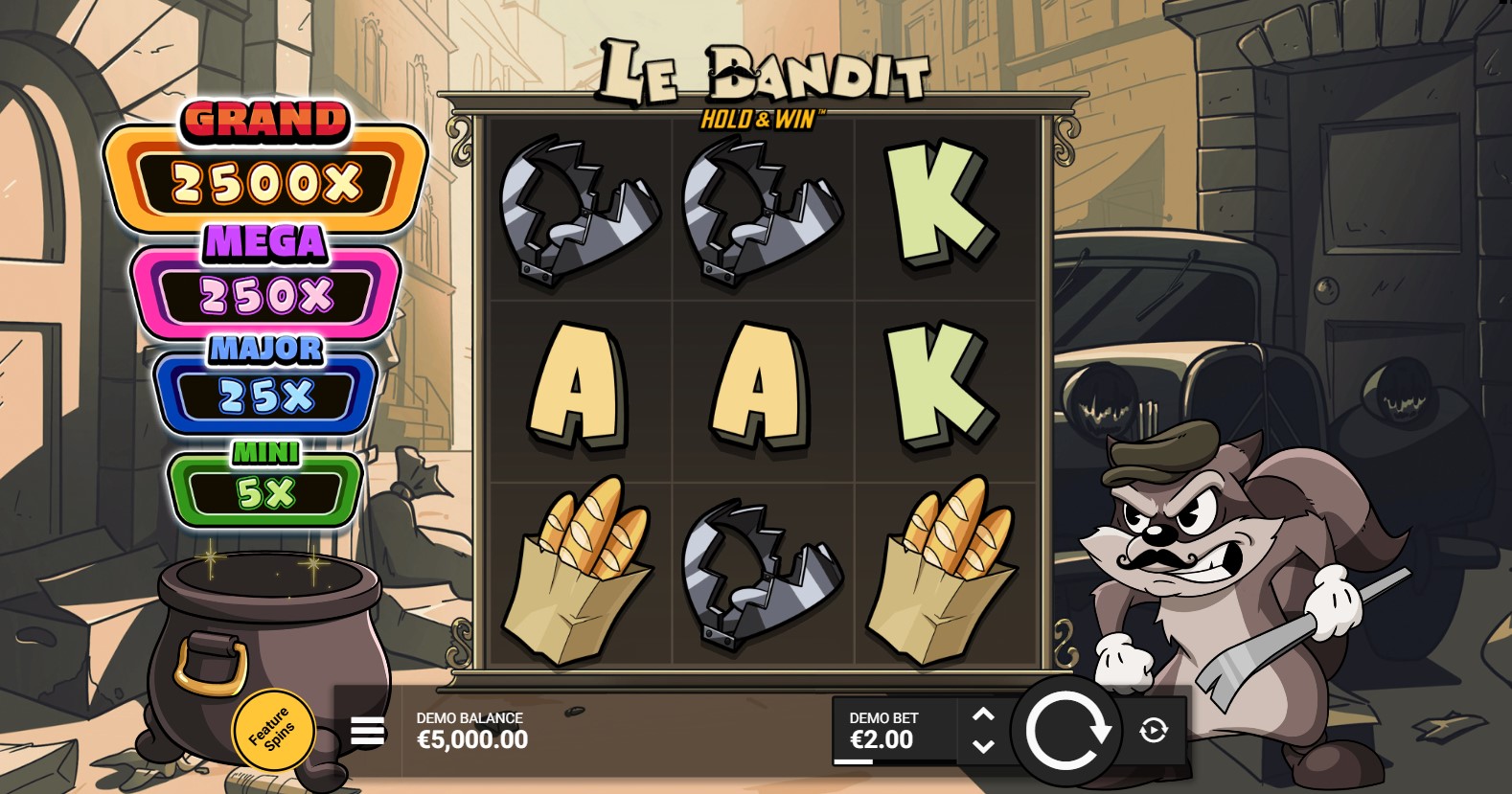
The original Le Bandit established a playful crime theme built around stolen cash and feature mechanics, and the Hold & Win version keeps that personality intact. Bags of money, coins, valuables, criminal paraphernalia, and the masked raccoon himself dominate the presentation, while the game’s animations become increasingly energetic whenever the feature begins collecting serious value.
I like the fact that Hacksaw hasn’t suddenly made the character serious simply because the mathematical structure has changed. Le Bandit Hold & Win still has the studio’s slightly twisted cartoon personality.
The raccoon looks like he has absolutely no intention of declaring any of this income.
Graphics and Presentation
Visually, the game remains unmistakably Hacksaw.
The artwork is compact and highly stylized rather than attempting photorealism. Symbols have thick, recognizable designs, feature icons are immediately identifiable, and the background provides enough detail to establish the criminal setting without distracting from the grid.
This becomes particularly important during Hold & Win.
Once several cash symbols are locked into position, you need to be able to read their values immediately. If modifiers, multipliers, and additional special symbols begin appearing at the same time, the screen can become mathematically busy even if the graphics themselves remain simple.
Hacksaw handles this well.
The visual hierarchy is clear.
Cash values matter.
Special symbols matter more.
And when something arrives that can change the entire feature, you know immediately.
How Le Bandit Hold & Win Plays
The base game provides conventional reel action while gradually introducing the mechanics that become more important inside the bonus.
Regular symbols create standard wins. Wilds help complete eligible combinations, while cash-style and bonus symbols provide access to the game’s larger feature system.
As with most Hold & Win slots, though, the base game is essentially preparing you for the main event.
You want enough qualifying symbols to trigger the feature.
Once that happens, the gameplay changes.
Instead of focusing primarily on conventional combinations, you’re looking at individual cash values, locked positions, remaining respins, multipliers, and special modifiers.
The objective becomes brutally simple:
Fill the board.
Increase the values.
Don’t let the feature die.
The Hold & Win Feature
The Hold & Win bonus is the centerpiece of the game.
Qualifying symbols trigger a separate feature state where cash-value symbols remain locked in position while empty spaces continue respinning. Landing another qualifying symbol generally resets the available respin counter, giving you additional opportunities to fill more positions.
It’s one of the simplest bonus structures in slots.
And one of the most effective.
The reason is psychological.
Every empty position represents potential.
If the board contains only a few cash symbols, you want more.
If half the grid is full, you start imagining what happens if you fill the rest.
If only one position remains empty, every respin becomes painful.
That’s why Hold & Win works.
You can literally see the missing piece.
Cash Symbols
Cash symbols carry individual values connected to the current wager.
At the beginning of the feature, those values may not look particularly exciting. A handful of modest amounts can produce an ordinary bonus even if several symbols are collected.
The situation becomes much more interesting when larger values appear or modifiers begin improving what’s already locked on the grid.
This creates two separate objectives.
You want quantity.
But you also want quality.
A completely filled board containing weak values might still be less exciting than a smaller collection that has received substantial multiplier or upgrade support.
The dream scenario is obviously both.
Lots of symbols.
Large values.
Useful modifiers.
That’s when Le Bandit has actually stolen something worth running away with.
Locked Symbols and Respins
Every newly locked symbol creates two things simultaneously: guaranteed value and less empty space.
That’s what gives the feature its natural progression.
At the beginning, the board can feel empty.
Then another symbol lands.
Respins reset.
Another arrives.
Reset again.
Now the grid looks completely different.
Suddenly you’re not thinking about triggering the bonus anymore. You’re thinking about filling the entire thing.
The respin counter creates constant pressure because every miss brings the feature closer to ending. Landing another qualifying symbol at the final possible moment is therefore much more satisfying than receiving the same symbol when the counter is already full.
The mathematics haven’t necessarily changed.
The tension has.
Multipliers
This is where Hacksaw starts making the familiar Hold & Win structure considerably more dangerous.
Multipliers can dramatically increase the value of already useful positions or influence the final collection, depending on the active feature configuration.
A modest cash symbol isn’t particularly exciting.
Multiply it several times and suddenly it matters.
Apply multiplier effects to multiple useful values and the entire feature can change.
This creates an important distinction between simply filling positions and improving the board.
You don’t necessarily want the feature to resolve immediately.
Sometimes you want another modifier first.
Another multiplier.
Another valuable cash symbol.
Then the collection.
That’s when the feature begins producing the kind of escalation expected from Hacksaw Gaming.
Special Modifiers
Special modifiers provide the additional layer Le Bandit Hold & Win needs to separate itself from thousands of generic Hold & Win slots.
These mechanics can influence the current feature state by improving values, adding additional symbols, affecting multipliers, or otherwise changing the mathematical value of the locked grid.
Their importance depends entirely on timing.
A powerful modifier appearing when the board is almost empty may accomplish relatively little.
The same modifier arriving after you’ve accumulated several valuable positions can be dramatically more important.
That’s what makes the feature interesting.
You aren’t simply waiting for anything to land.
You’re waiting for the right thing to land now.
Building the Board
The best Hold & Win bonuses have a clear sense of progression.
Le Bandit Hold & Win understands this.
The feature begins with a handful of symbols.
More positions become occupied.
Values improve.
Modifiers appear.
The respin counter repeatedly resets.
Now the board has transformed from something ordinary into a configuration where every additional symbol matters.
This is the point where the bonus becomes genuinely tense.
You’ve already accumulated enough value that you don’t want the feature to end.
But you can also see enough empty positions to imagine how much better it could become.
That’s the trap.
And it’s a very effective one.
The Last Empty Position
Anyone who plays Hold & Win slots knows this pain.
The board is almost full.
One position remains.
Respins: three.
Nothing.
Two.
Nothing.
One.
Spin.
You stare at the empty position.
The reel stops.
Wrong symbol.
Feature over.
Few slot mechanics create a more obvious near miss because the missing value is physically sitting there as an empty square.
Hacksaw knows how to exploit that tension.
And Le Bandit Hold & Win can be absolutely merciless with it.
Full-Grid Potential
Naturally, completely filling the available grid represents one of the feature’s major objectives.
A full board can activate additional value or provide access to one of the stronger outcomes associated with the Hold & Win structure.
But filling the board is only part of the story.
The values you’ve accumulated matter.
A full grid with heavily improved cash symbols and useful multipliers is a completely different result from one containing mostly minimum values.
That’s why the feature has more depth than simply counting occupied positions.
The ideal bonus needs several things to go right.
You need symbols.
You need good values.
You need modifiers.
You need enough resets.
And then you need the game to finish the job.
Simple.
Except it isn’t.
Wilds in the Base Game
Wild symbols help substitute for eligible regular paying icons during standard gameplay.
They’re useful, but they’re not really why most players will open Le Bandit Hold & Win.
The cash and bonus mechanics naturally receive most of the attention.
Still, useful Wild placement gives the base game enough activity that ordinary spins aren’t completely dependent on triggering the feature.
Premium combinations supported by Wilds can provide respectable results and help break up longer periods where the Hold & Win symbols refuse to cooperate.
But make no mistake.
You’re waiting for the robbery.
Feature Buy
Where permitted, Feature Buy options may provide direct access to the Hold & Win bonus or stronger feature configurations.
This will naturally attract Hacksaw players who don’t want to wait for an organic trigger.
But Hold & Win features can be particularly dangerous to purchase because the result can become obvious very quickly.
You pay the entry price.
The feature begins.
A few weak cash values land.
Nothing useful follows.
Respins disappear.
Done.
That can happen.
You’re purchasing access to the feature, not purchasing a profitable result.
Enhanced feature options may improve the starting conditions or increase access to stronger mechanics, but they also concentrate considerably more variance into a very short period.
Volatility – Le Bandit Can Steal From You Too
Le Bandit Hold & Win is a high-to-very-high volatility game, and the cheerful raccoon shouldn’t convince you otherwise.
The base game can produce extended quiet periods.
Bonus teases can fail repeatedly.
Cash symbols can appear one spin apart rather than together.
And even after triggering Hold & Win, the feature can die quickly.
That’s the ugly side.
You can enter the bonus expecting fireworks and leave with a handful of weak values.
But when the feature survives long enough, the opposite happens.
The board begins filling.
Values improve.
Multipliers become relevant.
Special modifiers arrive.
Respins keep resetting.
Suddenly you’ve gone from hoping for one additional symbol to staring at a nearly full grid with considerably more value than you started with.
That’s why the volatility works.
A Weak Bonus vs a Strong Bonus
The difference can be enormous.
A weak bonus might look like this:
A few symbols trigger the feature.
One additional low value lands.
Nothing.
Nothing.
Feature over.
That’s it.
A strong bonus develops completely differently.
New symbols arrive repeatedly.
Each one resets the respins.
The grid begins filling.
A multiplier improves several positions.
Another modifier adds more value.
A larger cash symbol lands.
Reset.
Another symbol.
Reset.
Now you’re one or two positions away from filling the entire board.
Same feature.
Completely different experience.
Sound and Atmosphere
Hacksaw’s sound design fits Le Bandit perfectly.
The base game uses playful criminal and heist-inspired audio without becoming too intrusive. Once the Hold & Win feature begins, the soundtrack becomes more focused and increasingly tense.
Each new cash symbol receives a satisfying confirmation sound.
Respins resetting feel important.
Modifiers have sharper effects.
Large values receive stronger treatment.
And when the board approaches full capacity, the audio naturally makes the situation feel considerably more dramatic.
This matters because Hold & Win is fundamentally about tension.
You need to feel that each remaining respin matters.
The sound helps enormously.
Le Bandit Hold & Win on Mobile
Hacksaw Gaming’s compact visual style works exceptionally well on smartphones.
Cash values remain readable in portrait mode, the respin counter is obvious, special modifiers are easy to identify, and the interface doesn’t waste valuable screen space.
This is particularly important during the Hold & Win feature.
You need to see the entire board at once.
You need to know which positions are occupied.
You need to read the values.
And you need to understand exactly how many respins remain.
The mobile version handles all of this comfortably.
Desktop naturally provides a larger presentation, but mechanically there is almost no reason to prefer one format over the other.
My Playing Experience
What I like most about Le Bandit Hold & Win is how quickly the game can change your objective.
Before the bonus, you’re desperately trying to trigger it.
Then it triggers.
Immediately, you stop caring about Scatters.
Now you want cash symbols.
Then several cash symbols arrive.
Now that’s not enough.
You want bigger values.
A multiplier appears.
Great.
Now you want another multiplier.
The board becomes almost full.
Forget the values.
Just give me the final bloody symbol.
That’s good bonus design.
Your objective keeps changing as the feature develops.
The closer you get to the strongest state, the more demanding you become.
The Frustrating Side
Hold & Win mechanics are incredibly good at showing you what you didn’t get.
That’s also their biggest weakness.
An ordinary losing spin disappears immediately.
A Hold & Win near miss leaves an empty position sitting directly in front of you.
You know exactly what was missing.
Le Bandit Hold & Win can make this particularly painful because the stronger modifiers create situations where the existing board already looks valuable.
Then the respins start disappearing.
Three.
Two.
One.
Nothing.
Gone.
The raccoon keeps the money.
That’s going to annoy people.
It also means you’ll remember the feature.
How Does It Compare With the Original Le Bandit?
The original Le Bandit established the character and provided a more distinctive feature structure, while Hold & Win moves the series toward one of the industry’s most familiar bonus formats.
That could easily have made the sequel feel less interesting.
Fortunately, Hacksaw’s modifier system gives the Hold & Win mechanic enough aggression to preserve the personality of the series.
Still, players who loved the original specifically because it didn’t feel like a conventional Hold & Win slot may prefer the earlier game.
This version is more immediately understandable.
The original feels more unusual.
Which one is better depends largely on what kind of feature you prefer.
What Could Be Better?
The biggest issue is obvious: there are already far too many Hold & Win slots.
The mechanic has been used by practically every major provider, so Hacksaw needs the Le Bandit character and its additional modifiers to prevent the game from feeling generic.
Fortunately, they mostly succeed.
But the underlying structure remains familiar.
The base game can also feel secondary because so much attention is concentrated on reaching Hold & Win.
And weak bonuses hurt.
Triggering the main feature only to receive a couple of insignificant values before the respins expire is never satisfying.
Finally, extreme feature volatility means the game won’t appeal to players looking for predictable balance movement.
Pros & Cons
Pros: Le Bandit Hold & Win successfully combines one of Hacksaw Gaming’s strongest characters with an immediately understandable bonus format. The Hold & Win mechanic creates excellent tension, locked cash values provide visible progression, multipliers and modifiers give the feature more depth than a generic respin game, and nearly full boards create genuinely exciting final spins. The visual design retains the personality of the original Le Bandit, while mobile optimization is excellent.
Cons: Hold & Win is one of the most overused mechanics in modern slots, weak bonuses can end extremely quickly, and the high volatility can create difficult base-game stretches. Valuable-looking boards can disappear without receiving the final modifier or symbol needed to unlock their real potential, while Feature Buy options can make short-term balance swings particularly aggressive.
Who Should Play Le Bandit Hold & Win?
Le Bandit Hold & Win is primarily for players who enjoy volatile cash-collection and respin mechanics but want something with more personality than the average Hold & Win release. Existing Le Bandit fans should immediately recognize the character and Hacksaw’s visual style, while players unfamiliar with the series won’t need much time to understand the bonus.
It’s particularly suitable if you enjoy watching a feature physically develop in front of you.
Empty board.
Half-full board.
Multipliers.
Improved values.
One position left.
Final respin.
That progression is the entire attraction.
Players who dislike Hold & Win mechanics or prefer frequent low-volatility payouts probably won’t be converted simply because there’s a raccoon involved.
Our Verdict
Le Bandit Hold & Win takes a mechanic we’ve seen hundreds of times and makes it considerably more interesting by injecting Hacksaw Gaming’s trademark volatility, visual personality, and modifier-driven escalation into it. The Hold & Win structure itself isn’t revolutionary, but the relationship between locked cash values, multipliers, special modifiers, and the possibility of developing a nearly full grid gives the bonus enough depth to remain entertaining.
What stood out most to me is how naturally the format fits Le Bandit. A thief collecting increasing piles of money across the board makes thematic sense, and watching the raccoon’s haul grow gives the feature a visible sense of progression. You start with a few values, add more, improve them, and eventually reach the point where one additional symbol could completely change the outcome.
Naturally, Hacksaw is equally happy to let that final symbol never arrive.
That’s the painful part.
But it’s also why the successful bonuses work.
Le Bandit Hold & Win doesn’t reinvent Hold & Win, but it does something arguably more useful: it takes an exhausted mechanic and gives it enough Hacksaw personality to make filling those final empty positions exciting again.
Rating: 9.4/10
Le Bandit is back for another robbery, only this time you can watch the loot pile up directly on the grid. Fill the board, improve the cash values, stack the useful multipliers, and pray the respin counter survives long enough to finish the job. Just remember one thing: Le Bandit is still the thief—and sometimes the balance he steals is yours.